🎲 Top Uses of Dice Rollers for Teachers and Classrooms
By The Wheel of Name Team ·
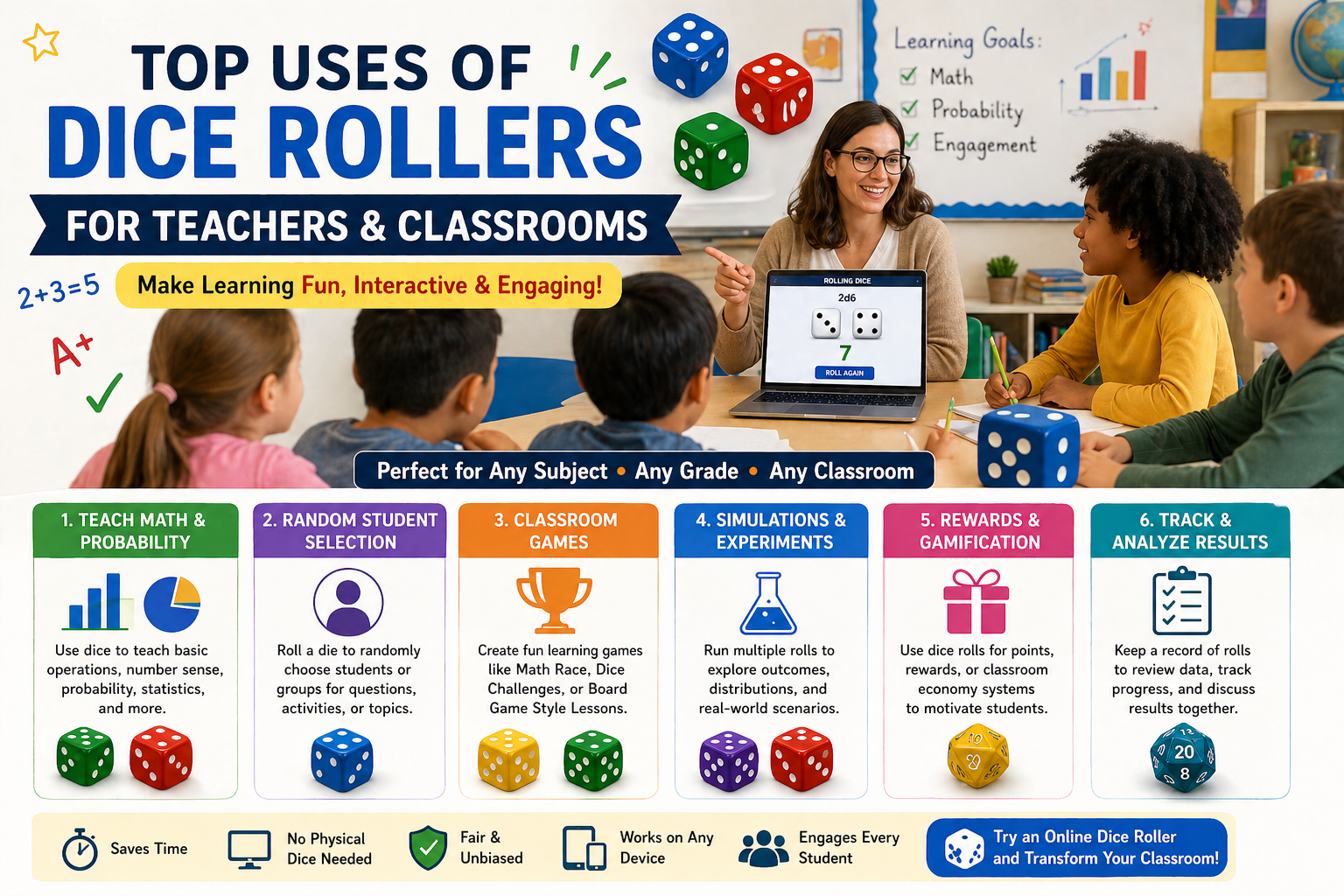
Online dice rollers are powerful tools for modern classrooms. They help teachers create interactive lessons, teach probability concepts, and engage students through fun, game-based learning. Unlike physical dice, digital dice are fast, fair, and easy to use on any device.
🧮 1. Teaching Probability and Math Concepts
- Demonstrate probability of outcomes (1/6, 2/6, etc.)
- Practice addition and number patterns
- Compare theoretical vs experimental probability
🎯 2. Random Student Selection
- Pick students fairly using dice numbers
- Avoid bias in participation
- Keep all students engaged
🎲 3. Interactive Classroom Games
- Math challenges based on dice rolls
- Quiz games with random scoring
- Group competitions
⚡ 4. Simulations & Experiments
- Run 100+ rolls instantly
- Visualize probability distributions
- Use for science and statistics projects
🏆 5. Rewards and Gamification
- Assign random bonus points
- Create reward systems
- Encourage participation
📊 Real-Life Example in Classroom
A teacher asks students to predict how often a number appears when rolling a die 50 times. Using an online dice roller, the class quickly runs the experiment and compares results with theory. This makes learning probability interactive and memorable.
❌ Common Mistakes Teachers Should Avoid
- Not explaining probability before using dice
- Using dice without clear learning goals
- Not tracking results for analysis
- Overusing randomness without structure
🔗 Related Guides
Learn more in our dice probability guide and online dice roller usage guide .
❓ Frequently Asked Questions
How can teachers use dice in classrooms?
Teachers use dice for math exercises, probability lessons, games, and random student selection.
Are online dice better for classrooms?
Yes, they are faster, more accurate, and easier to use on digital boards and devices.
Can dice help teach probability?
Yes, dice are one of the best tools for demonstrating probability concepts in a simple way.
Why Math Teachers Are Discovering Dice Rollers
There's a persistent challenge in teaching probability to students who have no intuition for it yet. You can explain that a six-sided die gives equal probability to each number all you want — students will nod and forget it the moment class ends. But when you ask them to predict how often they'll roll a 6 in 30 tries, then actually roll and count, something different happens. The prediction, the experiment, and the comparison all anchor the concept in a way that a formula on the board doesn't.
Online dice rollers accelerate this process dramatically. Instead of passing physical dice around a class of 30 students — half of whom will roll them off their desks — a teacher can project the roller on a screen, run 50 rolls in under a minute, and have the class tally results together. The same experiment that used to take a full class period can now happen in 10 minutes, leaving time to actually discuss what the data shows.
Classroom Activities That Work Well With Dice Rollers
The most straightforward classroom application is the law of large numbers experiment. Have students predict how many times each number will appear in 60 rolls of a d6. Then roll 60 times using the online roller, recording each result. Compare the actual distribution to the theoretical one-sixth frequency. Students who predicted "exactly 10 each" quickly learn that variance is normal — and that the distribution gets closer to even as you roll more times.
A more engaging version turns it into a game. Split the class into teams, each "owning" certain numbers on a d6. Roll 20 times. The team whose numbers appear most often wins a small prize. Then ask: was the winner lucky, or was there something about their numbers that helped? This leads naturally into whether all outcomes were equally likely — which they were — and why the results still varied.
Random Assignment for Classroom Management
Beyond math, dice rollers serve a practical classroom management function. Assigning students to groups randomly avoids the social dynamics of letting students self-select. A numbered roster and a dice roll solves this cleanly and transparently. Students accept random assignment more readily when they see the roll happen in real time on a shared screen. The same principle applies to calling on students, assigning presentation order, or deciding which team goes first in a classroom activity.
Gamification That Actually Works
Dice have a natural attention-grabbing quality that most classroom tools don't. One effective approach: use a d20 for challenge difficulty. Students answer a question or solve a problem, then roll the dice. A high roll might mean they earn bonus points or skip the next homework assignment. A low roll means they try a harder version of the same problem. This gamification works especially well with middle schoolers who respond to unpredictable outcomes.
Remote and Hybrid Classrooms
Remote classrooms created a practical problem: you can't share physical dice over a video call. An online dice roller projected on screen gives remote students the same visible result as those in the room. For students working independently on probability assignments, an online roller lets them run experiments without needing physical materials — a student at home can roll a virtual d6 one hundred times, record results in a spreadsheet, and submit a real data analysis without any special equipment.
⬅ Back to blogsShare this wheel:
I just used this fun wheel on thewheelofname.com 🎡 Try it!.