🎲 Rolling Multiple Dice: Tips for RPG and Board Games
By The Wheel of Name Team ·
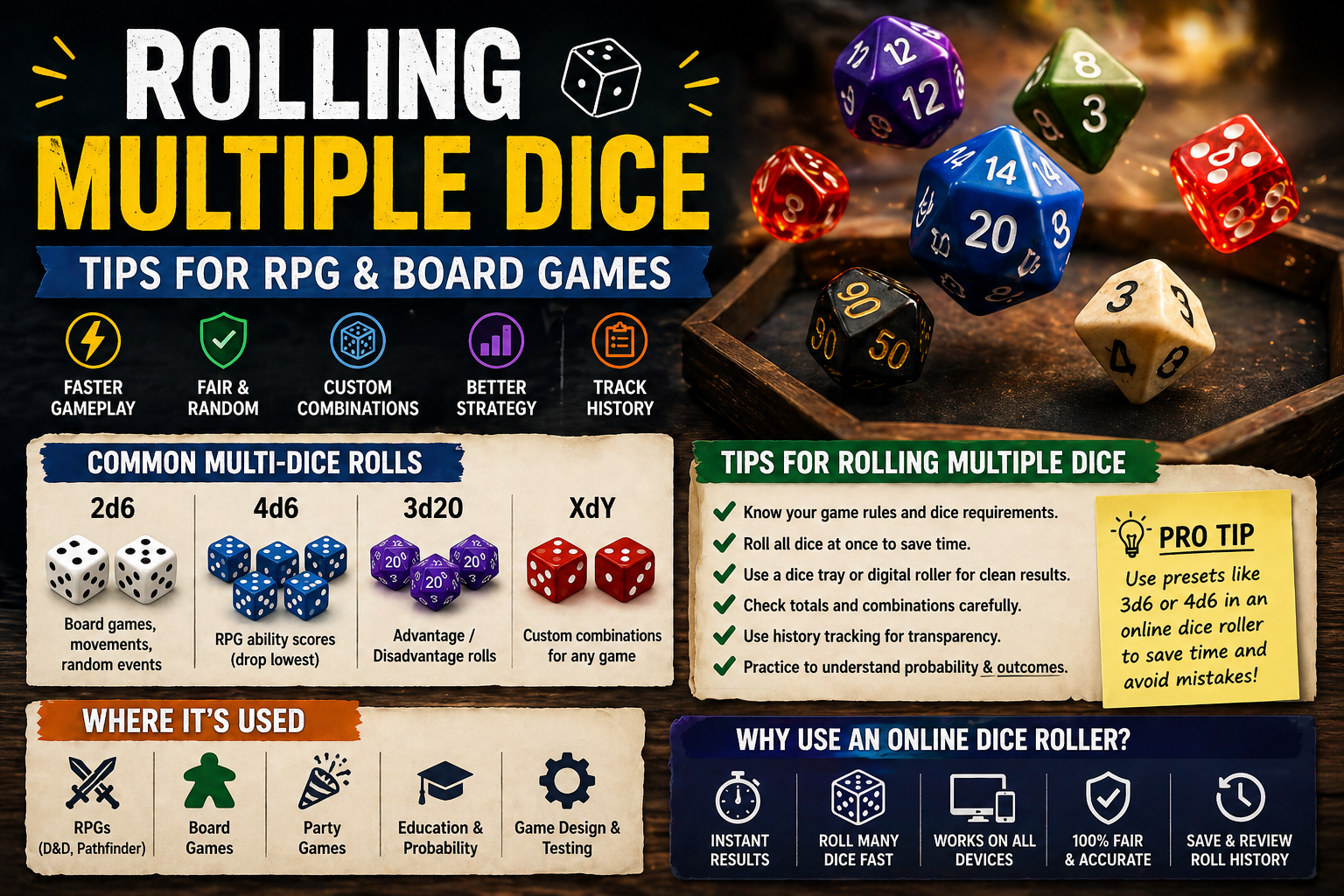
Rolling multiple dice is essential in RPGs, board games, and probability learning. Whether you're playing D&D, tabletop games, or using a digital dice tool, knowing how to roll efficiently improves gameplay speed, fairness, and accuracy.
🎯 Why Rolling Multiple Dice Matters
- Faster gameplay during complex turns
- Accurate probability distribution
- Better decision-making in strategy games
- Essential for RPG mechanics like damage rolls
⚔️ Real-Life Example (RPG Gameplay)
In Dungeons & Dragons, players often roll 4d6 and drop the lowest to generate character stats. Rolling multiple dice together speeds up the process and creates balanced outcomes compared to single rolls.
📊 How to Roll Multiple Dice Efficiently
- Roll all dice together instead of one-by-one
- Group dice by type (d6, d20, etc.)
- Use digital dice rollers for instant results
- Track totals and combinations carefully
🧮 Understanding Dice Combinations
- 2d6: Common in board games
- 4d6 drop lowest: RPG character stats
- 3d20: Advantage/disadvantage rolls
❌ Common Mistakes to Avoid
- Not tracking results correctly
- Using wrong dice combinations
- Ignoring probability impact
- Rolling too fast without checking totals
⚖️ Online Dice vs Physical Dice
- Physical Dice: Fun but slower and limited
- Online Dice Roller: Fast, accurate, supports multiple dice instantly
🔗 Related Guides
Learn more about probability in our dice probability guide .
❓ Frequently Asked Questions
How many dice should I roll?
It depends on your game. RPGs often require 2–6 dice per turn.
Is rolling multiple dice better?
Yes, it provides better probability distribution and faster gameplay.
Can I roll multiple dice online?
Yes, online dice rollers allow instant multi-dice rolling with accurate results.
When You Need Multiple Dice at Once
There's a moment in almost every RPG session when the dungeon master announces "roll 6d8 fire damage" and everyone starts counting how many d8s they actually own. Usually the answer is two. The workaround — rolling the same die six times in sequence — works, but it slows things down and loses the dramatic simultaneity of a big damage roll.
This is exactly where online dice rollers change the game. You type the notation, press roll, and all six results appear at once. The total is already calculated. The game moves on. For dungeon masters running encounters with multiple enemies, each needing their own attack and damage rolls simultaneously, the speed difference is significant.
Dice Notation: Reading the Language of RPGs
If you're new to tabletop RPGs, dice notation can look confusing at first. "4d6 drop lowest" or "2d20kh1" are common shorthand in character sheets and spell descriptions. The pattern is always the same: the number before "d" is how many dice to roll, the number after is the die type.
So 3d8 means roll three eight-sided dice. 2d6+3 means roll two six-sided dice and add 3 to the total. When you see "drop lowest," you're rolling extra dice and discarding the worst result — the standard method for generating D&D ability scores, where you roll 4d6 and ignore the lowest die. Understanding this notation lets you quickly set up any roll without thinking too hard about what the rules actually mean mechanically.
The Bell Curve Effect of Multiple Dice
Here's something that surprises new players: rolling 2d6 and rolling 1d12 produce very different distributions, even though both have a maximum result of 12. A single d12 gives equal probability to every number from 1 to 12 — a flat distribution. Two d6s create a bell curve, with 7 appearing most often and 2 or 12 appearing rarely.
This matters in games like Catan, where resource production is tied to the 2d6 roll. Hexes labeled 6 and 8 produce far more often than those labeled 2 or 12, and experienced players build accordingly. In damage rolls, using 2d6 instead of 1d12 means you're less likely to roll extremely low or extremely high — your damage becomes more consistent and predictable. Game designers choose dice configurations deliberately to create different feeling outcomes.
Strategies for Managing Multiple Physical Dice
If you prefer physical dice but need to handle large quantities, a few habits help significantly. First, keep dice separated by type. A small pouch or compartmented case lets you grab all your d6s instantly instead of sorting through a mixed pile mid-game.
Second, use a dice tray. Rolling multiple dice across a flat table often sends one or two rolling off the edge. A tray with low walls keeps everything in one spot and makes results easier to read. Third, for very large pools — 10 or more dice at once — rolling in two batches with one hand is usually faster and less chaotic than trying to throw everything simultaneously.
When to Switch to a Digital Roller
Even die-hard physical dice fans usually have a practical threshold. If you need more than six of the same die type and don't own that many, an online roller is the obvious solution. If your session is happening over video chat, physical dice aren't verifiable. If you're playing a solo game or doing character creation at home alone, an online roller is just faster.
The decision doesn't have to be binary. Many groups use physical dice for player rolls during the session — where the drama of the roll matters — and switch to a digital roller for background DM work: random encounter tables, NPC hit points, loot generation, and other behind-the-screen mechanics where speed matters more than atmosphere.
⬅ Back to BlogsShare this wheel:
I just used this fun wheel on thewheelofname.com 🎡 Try it!.