🎲 Dice Probability Explained With Examples
By The Wheel of Name Team ·
Understanding dice probability helps you predict outcomes in games, math problems, and real-life situations. Whether you're playing board games or learning probability, this guide will make it simple and clear.
🎯 What is Dice Probability?
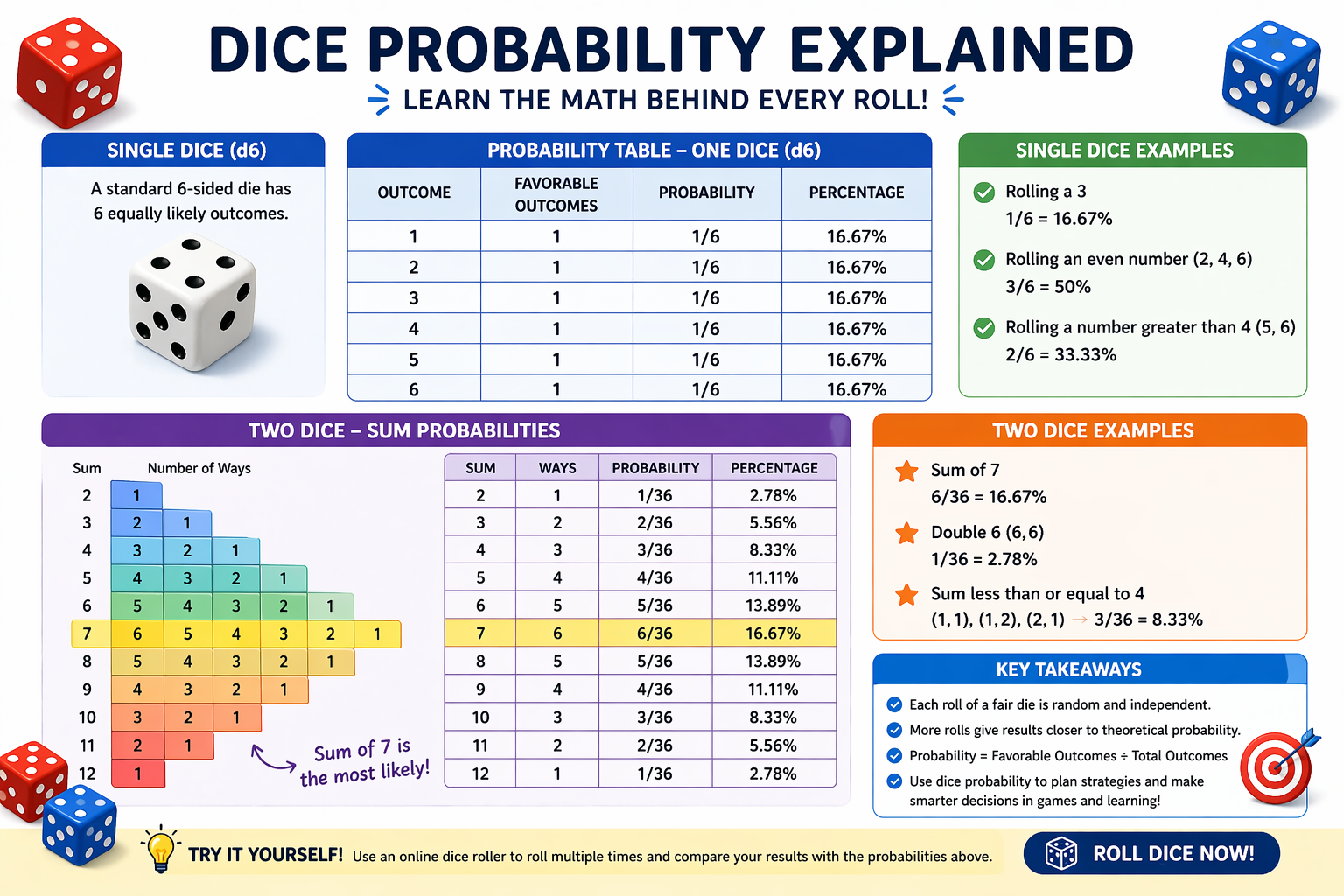
Dice probability is the chance of a specific outcome when rolling a die. A standard dice has 6 sides, so each number has an equal probability.
- 🎲 Total outcomes = 6
- ⚖️ Formula: Probability = Favorable Outcomes ÷ Total Outcomes
📊 Probability Table (Single Dice)
| Number | Probability | Percentage |
|---|---|---|
| 1 | 1/6 | 16.67% |
| 2 | 1/6 | 16.67% |
| 3 | 1/6 | 16.67% |
| 4 | 1/6 | 16.67% |
| 5 | 1/6 | 16.67% |
| 6 | 1/6 | 16.67% |
🎲 Examples
- Rolling a 3: 1/6 = 16.67%
- Even numbers: 2,4,6 → 3/6 = 50%
- Greater than 4: 5,6 → 2/6 ≈ 33%
🎲 Two Dice Probability
- Sum of 7: 6/36 ≈ 16.67%
- Double 6: 1/36 ≈ 2.78%
- Sum ≤ 4: 3/36 ≈ 8.33%
🧪 Theoretical vs Experimental
- Theoretical: Expected result (math)
- Experimental: Actual result (real rolls)
- 📊 More rolls = closer to theory
🌍 Real-Life Uses
- 🎮 Board games
- 🎲 Casino games
- 🧑🏫 Education
- 🎯 Game development
❓ FAQ
What is probability of rolling a 6?
1/6 or 16.67%
Most common sum of two dice?
7 is the most common
Does probability change?
No, each roll is independent
🎲 Try It Yourself
Use our tool to test probability in real-time.
Why Dice Probability Actually Matters in Real Games
Most people roll dice without thinking twice about what the numbers mean — you just grab the die, throw it, and hope for the best. But once you understand the math behind each roll, something shifts. You stop hoping and start making smarter decisions.
Take Catan, for example. Players who understand that 7 appears far more often than 2 or 12 place their settlements differently. They avoid spots that only score on a 2 or 12 — both have just one combination each — and instead grab the 6s and 8s, which each have five combinations. That single piece of knowledge can change the outcome of an entire game.
The Independence of Each Roll
One of the most misunderstood ideas in dice probability is independence. Each roll is completely separate from the one before it. If you roll five 6s in a row, the probability of rolling a 6 on the sixth roll is still exactly 1 in 6. The dice have no memory.
This trips people up constantly. You'll hear someone at a board game night say "I'm due for a high roll" after a streak of low numbers. That's the Gambler's Fallacy — the belief that past outcomes influence future ones. With fair dice, they don't. Every roll resets completely. The math doesn't care what happened before.
Experimental vs Theoretical: Closing the Gap
When you flip a coin 10 times, you might get 7 heads and 3 tails. Theory says you should get 5 of each — but theory assumes infinite trials. The same applies to dice. Roll a six-sided die 20 times and you might only see two 3s, even though probability says you should see about three.
This is where an online dice roller becomes genuinely useful for learning. You can run 500 rolls in under a minute and watch the results converge toward what the math predicts. The gap between your experimental results and the theoretical probability shrinks noticeably as your sample size grows. Rolling 1,000 times will almost always bring your observed frequencies within a percentage point of the theoretical values.
Applying Probability to Advantage Rolls
In Dungeons and Dragons 5th edition, the Advantage mechanic asks you to roll two d20s and take the higher result. This sounds like a small bonus, but the probability shift is dramatic. Your average roll on a single d20 is 10.5. With Advantage, the expected value jumps to about 13.8 — nearly three and a half points higher on average.
For a player trying to hit a target difficulty of 15, that difference is massive. Without Advantage, you succeed on an 11 or higher — a 50% chance. With Advantage, you succeed on a 15 or higher with either die, which works out to roughly a 56% chance of at least one die hitting. Probability doesn't just help you understand games — it helps you appreciate exactly how much each rule change affects your odds.
Using Our Dice Roller to Test Your Understanding
The best way to cement probability concepts is to see them in action. Set our dice roller to a standard d6 and roll it 100 times, recording how often each number appears. Compare your results to the theoretical 16.67% for each face. You'll almost certainly find that some numbers appear more often in short runs — that's normal variance — but over enough rolls, the distribution smooths out considerably.
Try the same experiment with two dice, adding the results. Count how often you get a 7 versus a 2 or 12. You'll see the bell curve take shape in your own data. It's one thing to read that 7 has six combinations — it's another to watch it appear almost six times more often than 2 in your own 200-roll experiment.
⬅ Back to BlogsShare this wheel:
I just used this fun wheel on thewheelofname.com 🎡 Try it!.