🎲 How Many Dice Do You Need? Full Guide
By The Wheel of Name Team ·
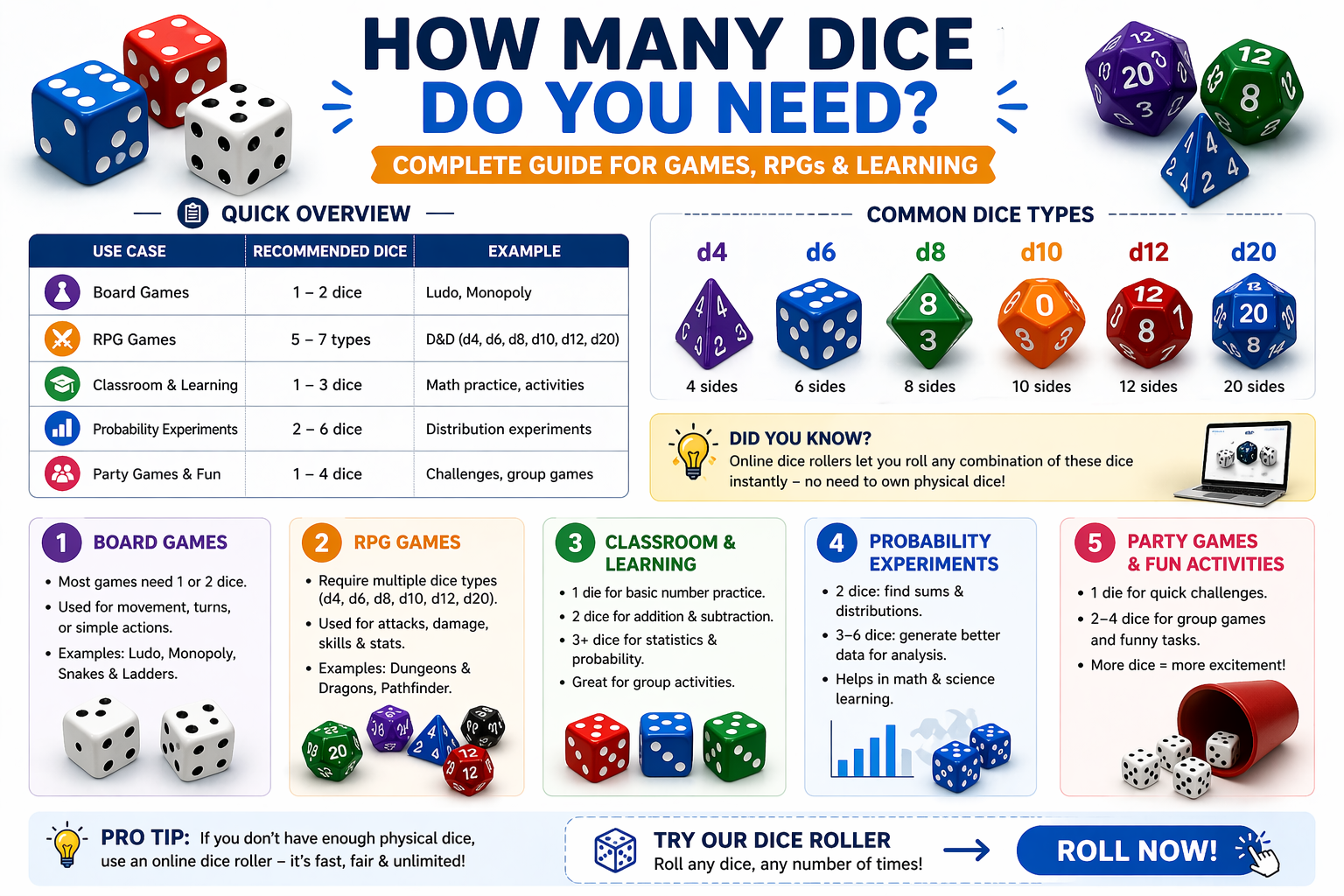
Choosing the right number of dice depends on your use case—whether you're playing board games, RPGs, teaching probability, or just having fun. This guide helps you understand exactly how many dice you need for each situation.
📊 Quick Overview Table
| Use Case | Recommended Dice | Example |
|---|---|---|
| Board Games | 1–2 dice | Ludo, Monopoly |
| RPG Games | 5–7 types | D&D (d4, d6, d8, d10, d12, d20) |
| Classroom | 1–3 dice | Math & learning |
| Probability | 2–6 dice | Distribution experiments |
| Party Games | 1–4 dice | Fun challenges |
🎯 1. Board Games
- Most games use 1 or 2 dice
- Examples: Ludo, Snakes & Ladders
- Some modern games use more dice for complexity
⚔️ 2. RPG Games (Dungeons & Dragons)
- Uses multiple dice types: d4, d6, d8, d10, d12, d20
- Character creation may require rolling 4d6
- Combat often uses multiple dice rolls
🧮 3. Classroom & Learning
- 1 die → basic counting
- 2 dice → addition/subtraction
- 3+ dice → statistics & probability
📊 4. Probability Experiments
Using more dice creates better statistical distributions. For example:
- 1 die → uniform distribution
- 2 dice → bell curve (most common sum = 7)
- 3+ dice → smoother probability curve
🎉 5. Party Games
- 1 die → simple challenges
- 2–4 dice → group games
- More dice → chaotic fun 😄
🔗 Related Guides
❓ FAQs
How many dice do I need for board games?
Usually 1 or 2 dice depending on the game rules.
How many dice are needed for RPG games?
Typically 6–7 different dice types (d4 to d20).
What is the best number of dice for probability?
2–6 dice are ideal for learning probability distributions.
Why the Answer Depends on What You're Playing
There's no single answer to how many dice you need because it depends entirely on what you play. A casual Yahtzee player needs five identical d6s and nothing else. A veteran D&D player might carry two or three complete polyhedral sets — d4, d6, d8, d10, d12, d20, and a percentile d10 — because different character abilities and spells use different die types. A Shadowrun player might need a literal bag of d6s to roll attacks at once.
The most honest starting point is to look at the rules of your specific game and identify which die types appear, then figure out the maximum number of any single type you'd need to roll at once.
The D&D Starter Setup
If you're new to Dungeons and Dragons, the minimum you need is a single complete polyhedral set: one d4, d6, d8, d10, d12, and d20, plus the percentile d10. This gets you through character creation and almost any spell or ability check. The d20 is the workhorse — you'll roll it far more than anything else, for attack rolls, saving throws, and ability checks.
Where a single set falls short is spellcasting damage. A fireball at higher levels might deal 12d6 fire damage. With one d6, you're rolling twelve separate times. Two sets give you two dice to roll six times. Three complete sets — which is what most active D&D players end up owning — means you can handle most situations in three or four rolls. Four sets covers virtually everything a player will ever need.
Dungeon Masters Need More
A player can get away with one set. A DM running a campaign with multiple monsters, traps, weather events, and random encounter tables will quickly discover that one set isn't enough. When five goblins each attack simultaneously, rolling one d6 five separate times slows the game noticeably.
Most experienced DMs keep at least two full sets — and a dedicated bag of d6s for monster damage. If you're running a high-combat campaign or a party of six players, budget for three or four sets. An online roller handles this more efficiently: type "8d6" and you get eight results simultaneously, which is why many DMs keep a dice roller open as a backup even when they have physical dice at the table.
Dice-Heavy Games: A Different Calculation
Shadowrun and other games with dice pools work differently. Your character might roll 14 or 16 dice on a single action, with each die contributing independently to the outcome. You add up successes rather than a total. For this style of play, you need a large quantity of a single die type — usually d6 — not variety.
A veteran Shadowrun player might own 20 to 30 d6s. Carrying that many dice in your bag is genuinely cumbersome, which is exactly why online rollers are popular in that community. Typing "20d6" and seeing the results in a single line is far faster than picking up a fistful of dice, rolling them across a table, counting successes, and re-rolling the ones that came up as "glitches."
Quality vs. Quantity
If you're buying physical dice, material matters more than most beginners expect. Cheap plastic dice from a dollar store are fine for casual play, but they wear down over time and aren't precision-balanced. Sharp-edged resin dice from specialty manufacturers are more consistent and more satisfying to handle. Gemstone dice — made from actual stone like obsidian or quartz — are beautiful collector items, but their weight makes them impractical for frequent rolling.
Metal dice are a middle ground: heavy, durable, and more balanced than cheap plastic, though they can damage table surfaces if you're not rolling on a dice tray. For most people, a good set of sharp-edged resin dice from a reputable maker will outlast years of play and roll more fairly than anything you'd pull out of a beginner board game box.
⬅ Back to BlogsShare this wheel:
I just used this fun wheel on thewheelofname.com 🎡 Try it!.