🎲 Why Online Dice Rollers Are Better Than Physical Dice
By The Wheel of Name Team ·
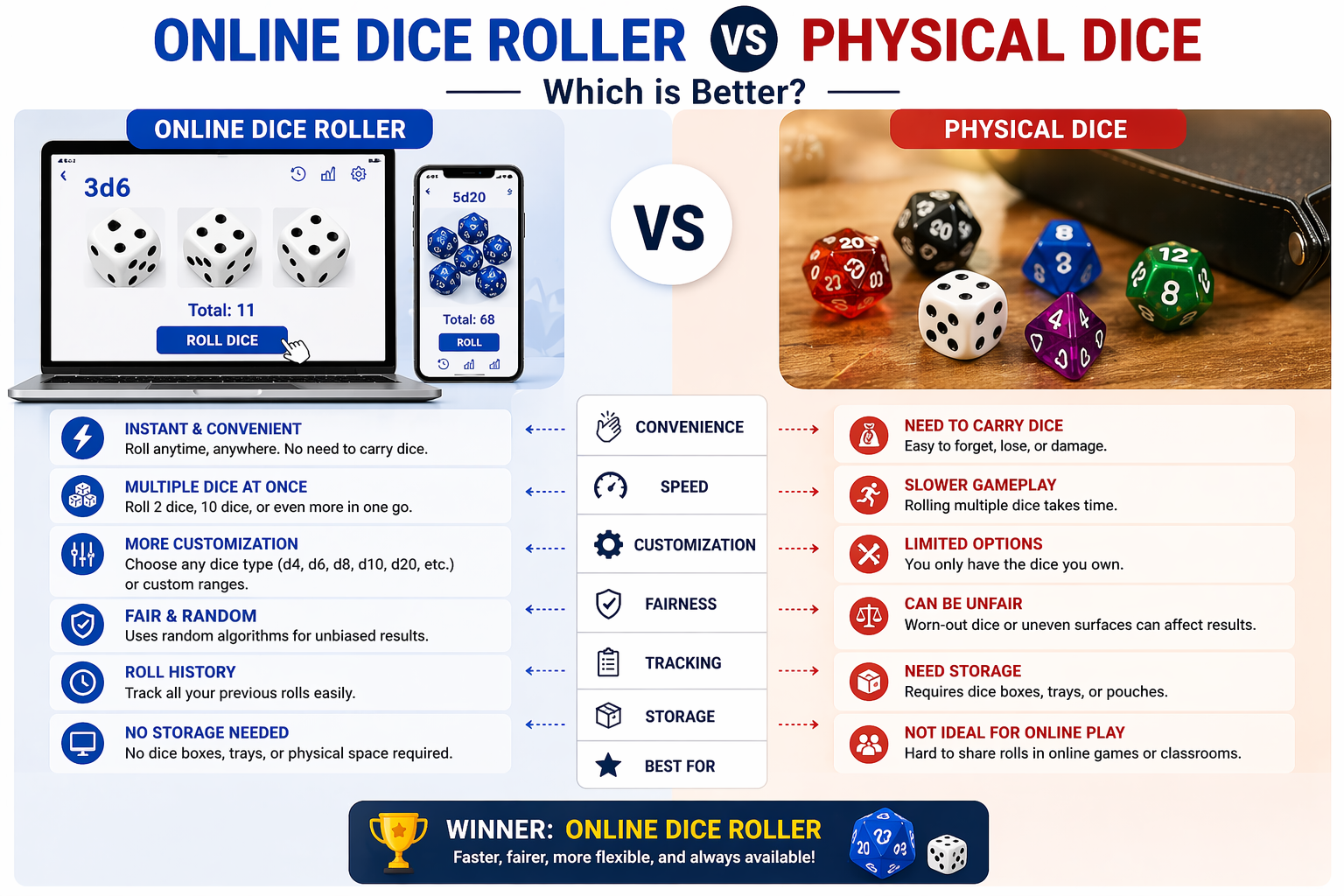
In modern gaming and learning environments, an online dice roller is becoming the preferred choice over traditional dice. Whether you're playing board games, RPGs, or learning probability, digital dice provide better speed, fairness, and flexibility.
🎯 1. Always Available Anywhere
- 📱 Works on mobile devices
- 💻 Accessible on laptops and desktops
- 🌐 No installation required
⚡ 2. Faster Gameplay
Rolling physical dice repeatedly can slow down games. Online tools allow instant results and multi-dice rolls, making gameplay smoother and faster.
🎮 3. Unlimited Customization
- Standard dice: d4, d6, d8, d10, d12, d20
- Custom ranges like 1–100
- Advanced rolls like 4d6 drop lowest
🏆 4. Fair and Random Results
Digital dice use algorithms to generate unbiased outcomes. Unlike physical dice, there is no wear and tear affecting results.
📊 5. Roll History & Tracking
- View previous rolls instantly
- Useful for transparency in games
- Great for probability experiments
📚 6. Better for Learning
Online dice rollers are ideal for students learning probability. You can simulate hundreds of rolls instantly and analyze results.
🔗 Related Guides
❓ FAQs
Are online dice rollers accurate?
Yes, they use random algorithms to ensure fair and unbiased results.
Can I roll multiple dice at once?
Yes, most tools support multi-dice rolls like 2d6, 4d6, or custom combinations.
Are online dice better for games?
Yes, they are faster, more flexible, and easier to use compared to physical dice.
The Moment You Realize Physical Dice Are Surprisingly Inconsistent
Most people assume that a six-sided die is perfectly balanced — six equal faces, one equal chance each. In practice, that's not always true. Cheap plastic dice, the kind that come packed inside most board games, are injection-molded with the number pips drilled or painted in. Those small indentations actually remove material, making some faces slightly lighter than others. A 6 has more material removed than a 1, which means the face opposite the 6 — the 1 — is marginally heavier, and the 6 has a fractionally higher chance of landing face-up on a truly cheap die.
Casino dice solve this by filling the pips with a paint that matches the density of the removed plastic, keeping all faces balanced. But those dice cost several dollars each, not a few cents. The dice in your game drawer are almost certainly not that precise.
The Lost Die Problem
Anyone who plays tabletop games regularly has lived through this: you're mid-session, you need to roll 4d6, and someone has already kicked one die under the couch. Now you're rolling one die four separate times and tracking the results in your head. Or someone needs to roll initiative for twelve NPCs simultaneously and you've only got two d20s between you.
An online dice roller eliminates this entirely. You specify exactly how many dice you need — 4d6, 8d8, twenty d20s — and get all the results at once. No hunting, no tracking, no waiting for someone to roll one die repeatedly. For a dungeon master running a large encounter, this alone is worth switching.
Speed and Accessibility
Think about how long a physical roll actually takes in a fast-paced game. Someone picks up the dice, rolls them across the table, one falls on the floor, someone argues about whether it counts because it's leaning against a book, it gets re-rolled, the result is finally read aloud, and someone writes it down. That's easily 30 seconds for a single roll.
Online, you click once and the result appears instantly. For games with lots of dice — large combat encounters in D&D, high-dice-count rolls in Shadowrun, or any wargame — the time savings are real and they let you spend more time actually playing rather than managing the mechanics.
When Physical Dice Are Still Worth It
Being honest here: there's something tactile and satisfying about picking up a handful of dice and throwing them. The sound of dice hitting a table is part of the atmosphere at a tabletop session. If your group is in the same room, gathered around a physical game, rolling real dice adds to the experience in a way that clicking a button doesn't replicate.
Physical dice also matter in games where the roll is the moment — where everyone leans in to see if the die lands on a 20. That theatre is real and it has value. The online roller is better for speed, consistency, and remote play. For pure in-person atmosphere, the old-fashioned roll across the table still wins.
Remote Play Changed Everything
When tabletop gaming moved online — whether through video calls with friends in different cities or dedicated platforms like Roll20 and Fantasy Grounds — physical dice became impractical. You can't verify what someone rolled over a video call. An online dice roller with transparent results solves the trust problem: everyone sees the same number at the same time, generated by the same source.
Even outside of RPGs, this matters. If your team is spread across three time zones and you need to randomly assign a task or settle a tie, a shared online roller is fairer and more transparent than "I rolled a 4 at my desk, trust me."
⬅ Back to BlogsShare this wheel:
I just used this fun wheel on thewheelofname.com 🎡 Try it!.