🎮 Random Number Generator for Games
By The Wheel of Name Team ·
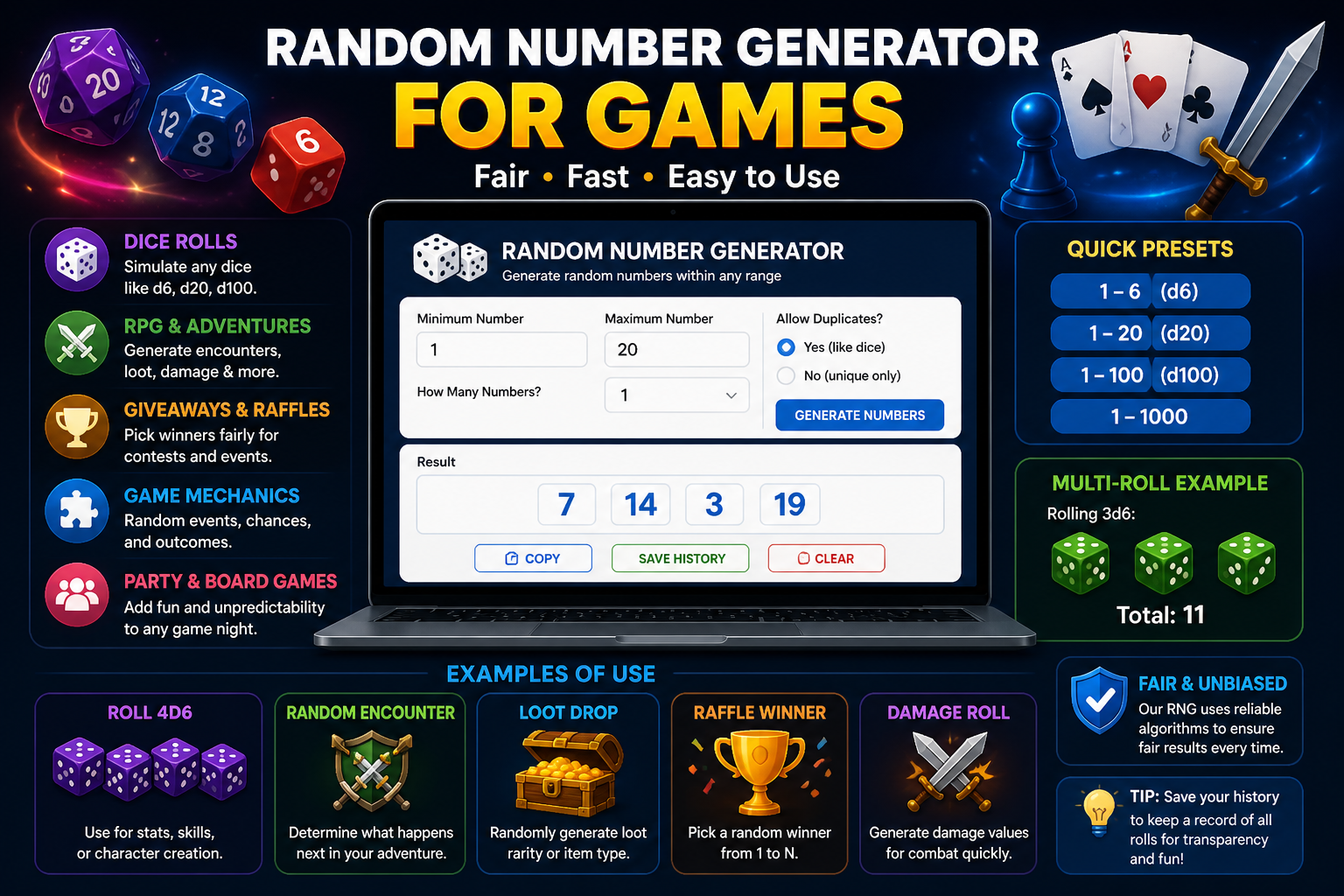
A Random Number Generator (RNG) is one of the most useful tools for games. Whether you play board games, RPGs, or online competitions, RNG helps create fair and unpredictable outcomes.
📌 Contents
🎲 When to Use RNG in Games
- Dice replacement: Simulate dice (d6, d20, etc.)
- Giveaways: Pick winners fairly
- RPG encounters: Random events & loot
- Game mechanics: Attack, damage, chance systems
- Online competitions: Fair selection system
⚙️ How to Configure RNG for Games
- Set Min = 1 and Max = 6 → for dice (d6)
- Use Multi-roll → simulate multiple dice
- Enable duplicates → real dice behavior
- Disable duplicates → raffle selection
🎯 Real Game Examples
- 4d6 roll: Generate 4 numbers (1–6)
- Pick winner: 1–100 random selection
- Damage system: Generate values like 1–8
- Loot drop: Random rarity system
💡 Pro Tips for Game Masters
- Use history tracking for transparency
- Use presets for quick gameplay
- Use sorting for ranking results
- Save logs for fairness proof
🔍 Popular Searches
- dice roller online free
- d20 random number generator
- rng for rpg games
- random number generator for games online
🎲 Try RNG for Your Game
Generate random numbers instantly for dice, games, and contests.
🚀 Start Generating NumbersAlso try Spin the Wheel or Lucky Winner Picker.
Dice Simulation in Detail
A standard d6 generates a number from 1 to 6. Our Random Number Generator matches this exactly — set min to 1, max to 6, and each result has a 16.7% probability, identical to a fair physical die. For a d20 used in Dungeons & Dragons and similar RPGs, set the range to 1–20. For advantage rolls (roll twice, take the higher), generate two numbers and use the larger one — this shifts the average from 10.5 to about 13.8.
For multi-die rolls (2d6 for Catan, 3d6 for character stat generation in classic D&D), generate multiple numbers and sum them. The distribution you get from 2d6 is a bell curve peaking at 7, unlike a flat single-die roll — which is why Catan's 7 is so powerful and why character ability scores cluster in the middle range in classic stat generation.
Giveaway and Contest Fairness
For online giveaways, the challenge is auditability — winners need to trust the selection was random. Using an RNG in a livestream is effective: announce the range (1 to number of entries), spin the generator on screen, and the numbered entry wins. This is easy to verify and hard to fake when done live.
For social media contests with large entry counts, the Lucky Winner Picker lets you paste all participant names and draws randomly — which is more convenient than numbering every entry manually.
When RNG Results Feel "Wrong"
Players sometimes feel that a die rolled digitally doesn't "feel" random — especially after several extreme results in a row. This is normal. Streaks of high or low numbers are expected in genuine random sequences; they're not evidence of bias. The discomfort comes from the Gambler's Fallacy — the incorrect intuition that past results influence future ones in a system with no memory.
If a game group doesn't trust digital RNG, showing the history log helps. A long enough
sequence will show all values appearing roughly equally. For high-stakes competitive play,
hardware random number generators exist, but Math.random() is statistically
indistinguishable from fair dice for any game played casually.
❓ FAQs
Can I use RNG instead of dice?
Yes, RNG can fully replace dice rolls in games.
Is RNG fair for games?
Yes, RNG provides unbiased results for most gaming purposes.
Can I simulate multiple dice?
Yes, use multi-roll to generate multiple numbers at once.
Share this wheel:
I just used this fun wheel on thewheelofname.com 🎡 Try it!.