🔐 Secure vs Non-Secure Random Number Generators
By The Wheel of Name Team ·
Random Number Generators (RNGs) are a fundamental part of modern software systems. From simple games and simulations to encryption, authentication, and financial systems, randomness plays a critical role in ensuring fairness, unpredictability, and security.
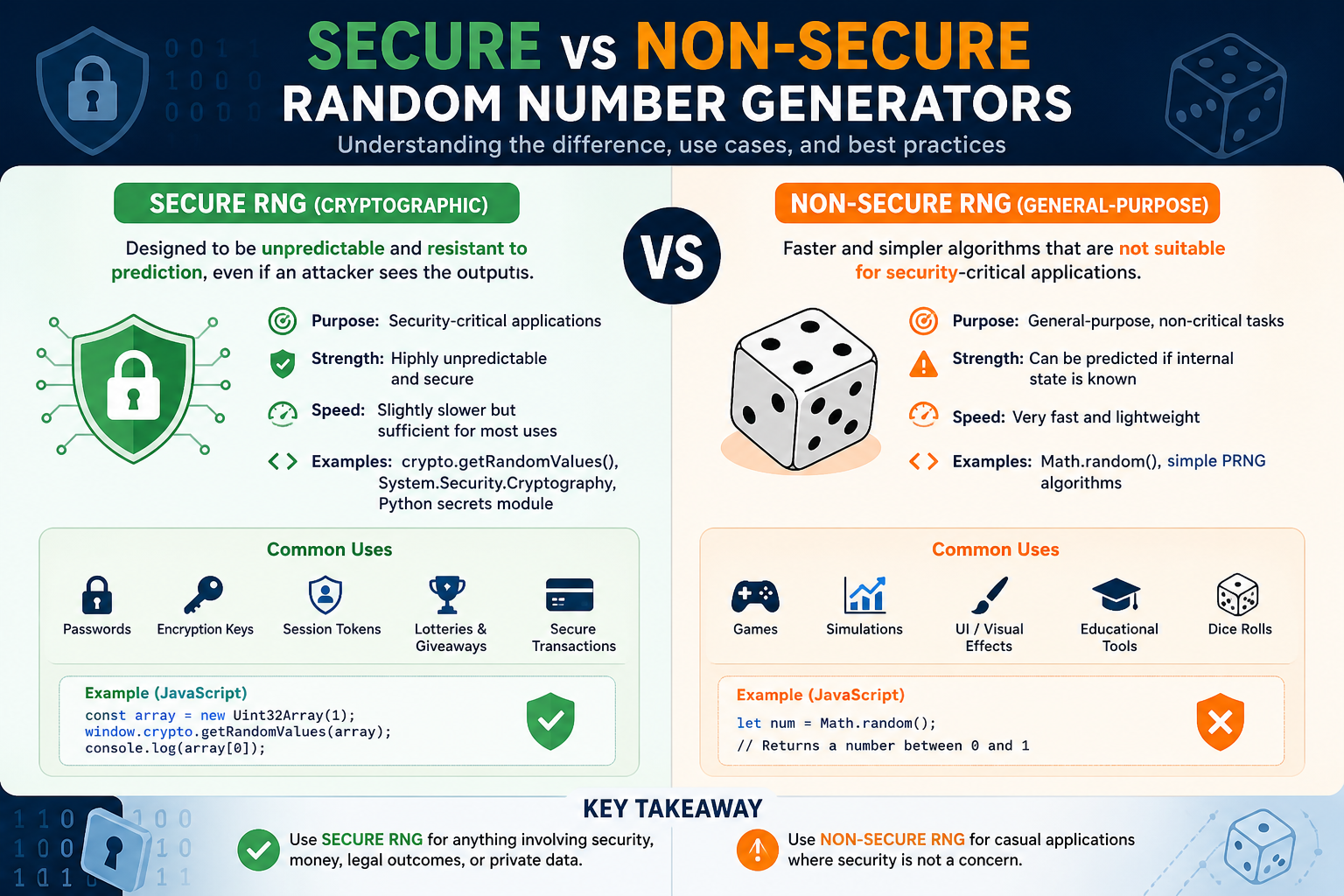
However, not all random number generators are created equal. They are broadly divided into two categories: non-secure (general-purpose RNGs) and secure (cryptographic RNGs). Understanding the difference between these two is essential for developers, educators, and anyone building or using digital tools.
What is a Random Number Generator?
A Random Number Generator is an algorithm or system designed to produce a sequence of numbers that lack any predictable pattern. Most software-based RNGs are actually pseudo-random, meaning they use mathematical formulas to simulate randomness.
The key difference lies in how unpredictable and secure those numbers are.
Non-Secure RNGs (General-Purpose)
Non-secure RNGs are designed for speed and efficiency rather than security. These generators are commonly used in applications where randomness is needed, but predictability does not pose a risk.
- Common Uses: Games, UI animations, simulations, educational tools.
- Performance: Very fast and lightweight.
- Predictability: Can be predicted if the internal algorithm or seed is known.
- Examples: JavaScript
Math.random(), basic PRNG algorithms.
Example (JavaScript)
Math.random() generates a number between 0 and 1:
let num = Math.random();While this is sufficient for casual applications like games or number picking tools, it should never be used for sensitive operations.
Secure RNGs (Cryptographic)
Secure RNGs, also known as Cryptographically Secure Random Number Generators (CSPRNGs), are designed to be unpredictable even if an attacker has partial knowledge of the system.
- Common Uses: Passwords, tokens, encryption keys, secure authentication.
- Security: Resistant to prediction and reverse engineering.
- Performance: Slightly slower but still efficient.
- Examples:
window.crypto.getRandomValues(), .NET RNG, Python secrets module.
Example (JavaScript Secure RNG)
const array = new Uint32Array(1);
window.crypto.getRandomValues(array);
console.log(array[0]);
Key Differences Between Secure and Non-Secure RNG
- Predictability: Non-secure RNGs can be predicted; secure RNGs cannot.
- Use Case: Non-secure for casual tasks, secure for sensitive operations.
- Speed: Non-secure is faster, but secure is still performant.
- Security Level: Secure RNGs meet cryptographic standards.
When Should You Use Each?
Use Non-Secure RNG When:
- Building games or UI features
- Generating random practice numbers
- Running simulations or educational tools
Use Secure RNG When:
- Generating passwords or tokens
- Handling financial transactions
- Creating lottery or giveaway systems
- Working with authentication systems
Real-World Examples
- Game Dice Roll: Non-secure RNG is acceptable.
- Password Generator: Must use secure RNG.
- Online Lottery: Requires secure RNG for fairness and trust.
- Math Practice Tool: Non-secure RNG is sufficient.
Common Mistakes to Avoid
- Using
Math.random()for password generation - Building authentication tokens with non-secure RNG
- Assuming all randomness is secure
Best Practices
- Always use built-in cryptographic libraries
- Never build your own RNG for security purposes
- Use HTTPS and secure environments
- Test randomness if used in critical systems
Frequently Asked Questions
Is Math.random secure?
No, it is not suitable for security-related tasks.
What is a cryptographic RNG?
It is a generator designed to be unpredictable and secure for sensitive applications.
Do I need secure RNG for a math tool?
No, general-purpose RNG is sufficient for educational tools.
Are secure RNGs slower?
Slightly, but not enough to impact most applications.
Conclusion
Choosing between secure and non-secure random number generators depends entirely on your use case. While non-secure RNGs are perfect for everyday applications like games and math tools, secure RNGs are essential when dealing with sensitive data and security-critical operations.
Understanding this difference helps you build safer, more reliable, and trustworthy applications.
Share this wheel:
I just used this fun wheel on thewheelofname.com 🎡 Try it!.