Coin Toss vs Random Number Generator – Choosing the Right Tool
By The Wheel of Name Team ·
Both tools produce random outcomes, but they solve different problems. Choosing the wrong one is usually harmless — but knowing which fits your situation makes the result feel more appropriate and accepted by everyone involved.
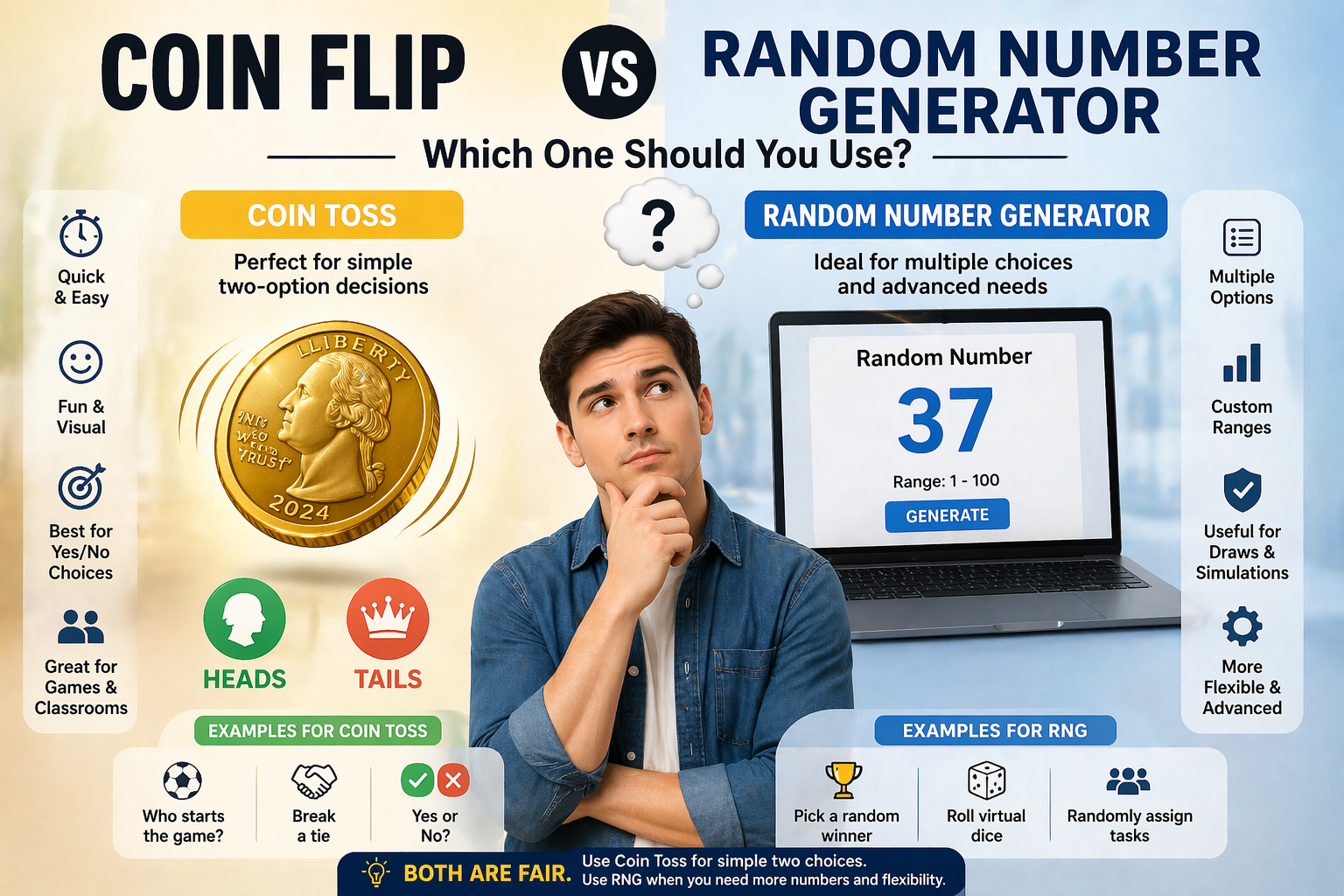
The Core Difference
A coin toss has exactly two outcomes: Heads or Tails. A random number generator has as many outcomes as you define — pick any range from 1–2 to 1–1,000,000. The right choice usually comes down to how many options you have.
If you're deciding between two things, use the coin toss — it's visually immediate and the result carries the cultural weight of a "fair flip." If you have three or more options, a coin toss requires multiple rounds and gets confusing fast. An RNG handles any number of options in one shot.
When the Coin Toss Wins
Coin tosses are better when the outcome needs to be witnessed and easily understood. Two people on a video call, two players deciding who goes first in a board game, a teacher picking which student reads next — in all of these, "it landed on Heads" is immediately clear to everyone. No one needs to know the range or interpret a number.
Coin flips are also better for emotional situations. When two people are making a decision together and neither wants to choose (to avoid responsibility for the outcome), the coin flip offloads the decision to chance in a way both parties easily accept. The visual of a flipping coin makes the process feel ceremonial.
When the RNG Wins
Random number generators are better for anything involving more than two options: picking a number to assign to a raffle ticket, selecting a random page of a book to start reading, generating a dice roll in tabletop games, or assigning a random seat number.
RNGs also work better for sequences. If you need 10 unique random numbers between 1 and 50, an RNG with "no duplicates" mode handles that in one operation. A coin toss can't.
A Practical Comparison
| Situation | Best Tool |
|---|---|
| Who pays for lunch (two people) | Coin toss |
| Which of three movies to watch | RNG 1–3 or spin wheel |
| Who goes first in a game | Coin toss |
| Picking a raffle winner from 50 entries | RNG or Lucky Winner Picker |
| Best-of-5 game tie-breaker | Coin toss |
| Assigning random homework problems | RNG with range |
Frequently Asked Questions
Are both tools equally random?
Both use Math.random() under the hood — the same pseudorandom algorithm.
The randomness quality is identical; the interface and output format differ.
Can I use the coin toss for three options?
You can run two rounds (e.g., A vs B, then winner vs C) but this creates unequal
probabilities — the option that gets a bye in round one has an advantage. An RNG
from 1 to 3 gives exactly equal odds.
Try both: Coin Toss | Random Number Generator
When the Choice Between Them Matters
For most everyday decisions, a coin toss and a random number generator produce functionally identical outcomes — both give you a fair random result, and the decision gets made. The difference matters at the edges: when you have exactly two options of equal weight and want the simplest possible mechanism, the coin toss wins on clarity. When you have a range of numbers, a weighted outcome, or more than two choices, a random number generator is the right tool.
The other difference is familiarity. A coin toss result is immediately understood by anyone. A random number from a generator requires the group to agree on what the number means — which number maps to which option, what the range is, whether repeats are allowed. This translation step is worth it when you need the precision, but for a simple two-choice decision it adds unnecessary complexity.
Try Coin Toss ToolShare this wheel:
I just used this fun wheel on thewheelofname.com 🎡 Try it!.