Coin Toss Games for Kids – Activities That Actually Teach Something
By The Wheel of Name Team ·
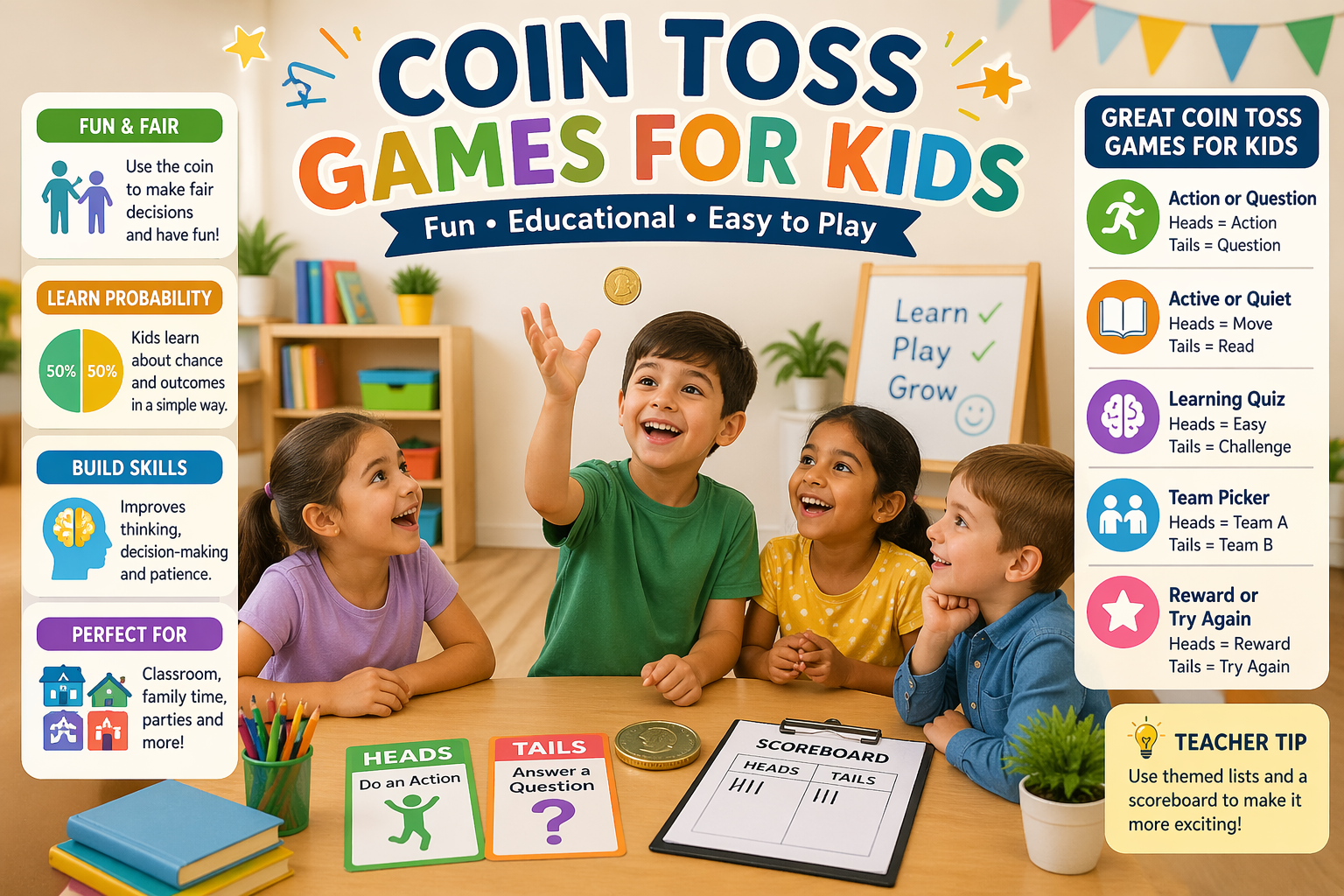
A coin toss is one of the best teaching tools for young children because the outcome is immediate, binary, and visually concrete. Kids understand "Heads or Tails" before they understand probability — and that intuition becomes the foundation for the concept. These games use that simplicity to build math skills, decision-making, and emotional regulation without feeling like school.
Probability Tracker (Ages 7+)
Give each child a simple tally sheet with two columns: Heads and Tails. They flip 20 times (using the online coin toss tool works well for groups) and mark each result. At the end, compare tallies across the class. Some kids will have 12 Heads, some 8 — ask why the results differ even though the coin "should" be 50/50. This introduces sample size and variance in a way kids can see directly in their own data.
Heads or Tails Story Game (Ages 5–8)
Start a group story. Before each sentence, flip a coin: Heads means the story takes a positive turn ("and then they found a treasure"), Tails means a challenge ("but suddenly it started raining"). Kids take turns adding sentences based on the flip result. It teaches narrative structure while making the randomness feel like a creative constraint rather than a problem.
Decision-Making Practice (Ages 6+)
This one's subtle but effective. When a child is stuck between two choices, have them assign Heads to one option and Tails to the other, then flip. Before they look at the result, ask: "Which one are you hoping for?" Often, kids already know what they want — the coin just reveals it. This teaches them to check their own preferences before outsourcing the decision to chance.
Classroom Warm-Up Flip (Ages 5+)
Assign two actions to Heads and Tails (e.g., Heads = do five jumping jacks, Tails = say the alphabet backwards). Flip at the start of class to pick the warm-up. Kids are surprisingly invested in the outcome. Works especially well on a projected screen where the whole class sees the same flip — use the online tool so everyone gets the same animated result.
Best-of-5 Fairness Experiment (Ages 8+)
For older kids: ask who thinks they can "beat" the coin — predict the outcome more than 50% of the time over 30 flips. Track predictions alongside results. Most kids start to recognize their own patterns (they keep predicting Heads after a run of Tails) and understand why they can't actually beat pure randomness. This is one of the clearest introductions to the Gambler's Fallacy available without textbooks.
Frequently Asked Questions
What age is appropriate for coin toss games?
Even children aged 4–5 understand Heads or Tails as two separate outcomes.
The probability concepts layer in around ages 7–9, once they can track results
and compare them to expectations.
Is online coin toss better than a real coin for classroom use?
For group activities, yes. Everyone sees the same animated result, history is tracked
automatically, and there's no argument about whether the coin was flipped fairly
or caught cleanly.
Also see: more coin activities | Try Coin Toss
Why Coin Toss Games Build More Than Just Luck Skills
The value of coin toss games for kids isn't just the entertainment — it's the natural exposure to probability, fairness, and the idea that some outcomes are genuinely random. Children who play coin toss games regularly start to understand intuitively that the coin has no memory, that past results don't predict future ones, and that a fair mechanism produces equal outcomes over time even if short streaks look unequal. These are concepts that formal probability lessons often struggle to land, but that make immediate sense through play.
Try Coin Toss ToolShare this wheel:
I just used this fun wheel on thewheelofname.com 🎡 Try it!.