🧠 How to Use a Decision Maker Tool to Make Better Choices
By The Wheel of Name Team ·
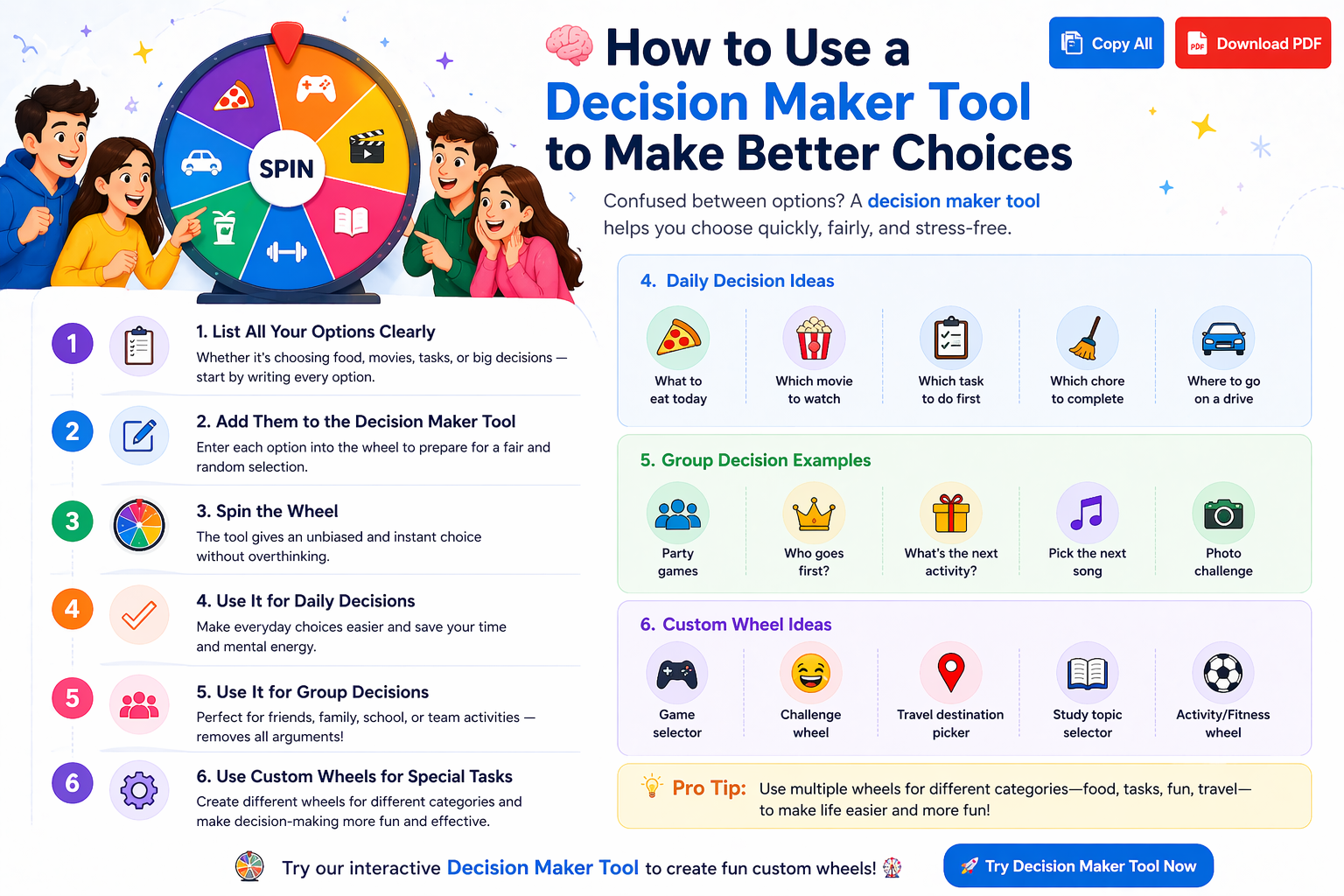
Confused between options? A decision maker tool helps you choose quickly, fairly, and without stress. This step-by-step guide will show you how to use it effectively in real life. 🎯
🤔 What Is a Decision Maker Tool?
A decision maker tool (also called a decision wheel or random picker) allows you to enter multiple options and randomly select one. It removes bias, saves time, and helps you avoid overthinking.
✨ Step-by-Step Guide
1. List All Your Options Clearly
Start by writing down every possible option. The more complete your list, the better your result.
2. Add Options to the Tool
Enter each option into the decision wheel. Most tools allow you to customize labels, colors, and categories.
3. Spin the Wheel
Click the spin button and let the tool randomly choose for you. This eliminates emotional bias.
4. Accept the Result
The key is commitment. Avoid re-spinning unless you genuinely need another round.
📊 Real-Life Use Cases
- 🍽️ Choosing what to eat
- 🎬 Picking a movie or show
- 📚 Deciding which task to do first
- 👥 Group decisions with friends
- 🎯 Business or productivity choices
⚖️ Why It Works (Psychology Behind It)
Decision fatigue is real. When you make too many choices, your brain gets tired. A random decision tool reduces mental load and helps you move forward quickly.
🚀 Advanced Tips for Better Results
- ✔ Use categories (Food, Work, Fun)
- ✔ Limit options to 5–10 for better clarity
- ✔ Remove low-priority choices
- ✔ Use it consistently to build habit
🔄 Decision Maker vs Overthinking
Instead of spending 30 minutes thinking, you can decide in 5 seconds. That’s why decision tools are powerful for productivity and mental clarity.
❓ Frequently Asked Questions (FAQs)
Is a decision maker tool really random?
Yes, most tools use random algorithms to ensure unbiased results.
Can I trust the result?
For everyday decisions, absolutely. For critical decisions, use it as guidance.
When should I NOT use it?
Avoid using it for life-changing or high-risk decisions.
Is it better than flipping a coin?
Yes, because it supports multiple options instead of just two.
🧭 Final Thoughts
A decision maker tool is simple but powerful. It helps you act faster, reduce stress, and make fair choices. Use it daily and you’ll notice better productivity and less overthinking.
👉 Try our Decision Maker Tool and start making smarter choices instantly! 🎡
When You Actually Need a Decision Maker Tool
There are two types of decisions people use a decision maker for. The first is genuine uncertainty — you actually can't decide between two or three options that seem equally good, and spinning a wheel gives you a result you'll commit to. The second is decision fatigue — you know what you probably want, but you're too tired of thinking to go through the process of justifying it. Both are legitimate.
For genuine uncertainty, the wheel provides a fair resolution mechanism that everyone in the group can accept. For decision fatigue, the wheel does something more interesting: when the result appears, your immediate emotional reaction tells you whether that was the right answer. Relief means yes. Disappointment means no. The wheel hasn't made the decision — it's revealed a preference you already had but hadn't committed to.
Setting Up Your Options Correctly
The quality of your decision depends heavily on what you put in. If you list six options but two of them are half-hearted additions you'd never actually choose, you're introducing noise. Before spinning, be honest about which options are real. Remove anything you'd regret landing on. If that leaves you with one option, you already know what you want to do — the decision was never actually open.
Some people use a rule before spinning: if you'd be unhappy with any result, don't spin — reconfigure your options first. The wheel should contain things you'd actually be fine with, even if some are more preferred than others. A spin result you'd immediately veto is a sign the setup was wrong, not that the tool failed.
Group Decisions and the Fairness Problem
Decision making in groups has a fairness problem. The person who speaks most confidently tends to win, regardless of whether their preference is objectively better. The person with the most social capital in the group often gets deferred to. Quieter members rarely push back even when they have strong preferences.
A decision wheel removes the social hierarchy from the process. Every option spun in has an equal probability, regardless of who suggested it or how enthusiastically. This is particularly useful in groups where power dynamics or personality differences make genuine consensus difficult. The wheel is fair in a way that group discussion rarely is.
Using the Tool for Daily Micro-Decisions
Decision fatigue is a real phenomenon — the quality of decisions degrades as the number of decisions made in a day increases. This is why some high-performers deliberately reduce the number of trivial decisions they face: the same meal on rotation, a fixed work uniform, a pre-set schedule that removes daily choice about how to structure the morning.
A decision maker tool extends this approach. What to have for lunch, which task to start with, which TV show to watch tonight — offloading these micro-decisions to a wheel preserves mental capacity for decisions that actually matter. The wheel result isn't always optimal, but "good enough and decided" beats "optimal but paralyzed" for most daily choices.
⬅ Back to BlogsShare this wheel:
I just used this fun wheel on thewheelofname.com 🎡 Try it!.